Photography · the still frame
Composition, natural + stage light, sanctuary shooting without disrupting worship, colour science for skin under LED wash, the archival ethic. Bring your body; a camera is provided if you don't have one.
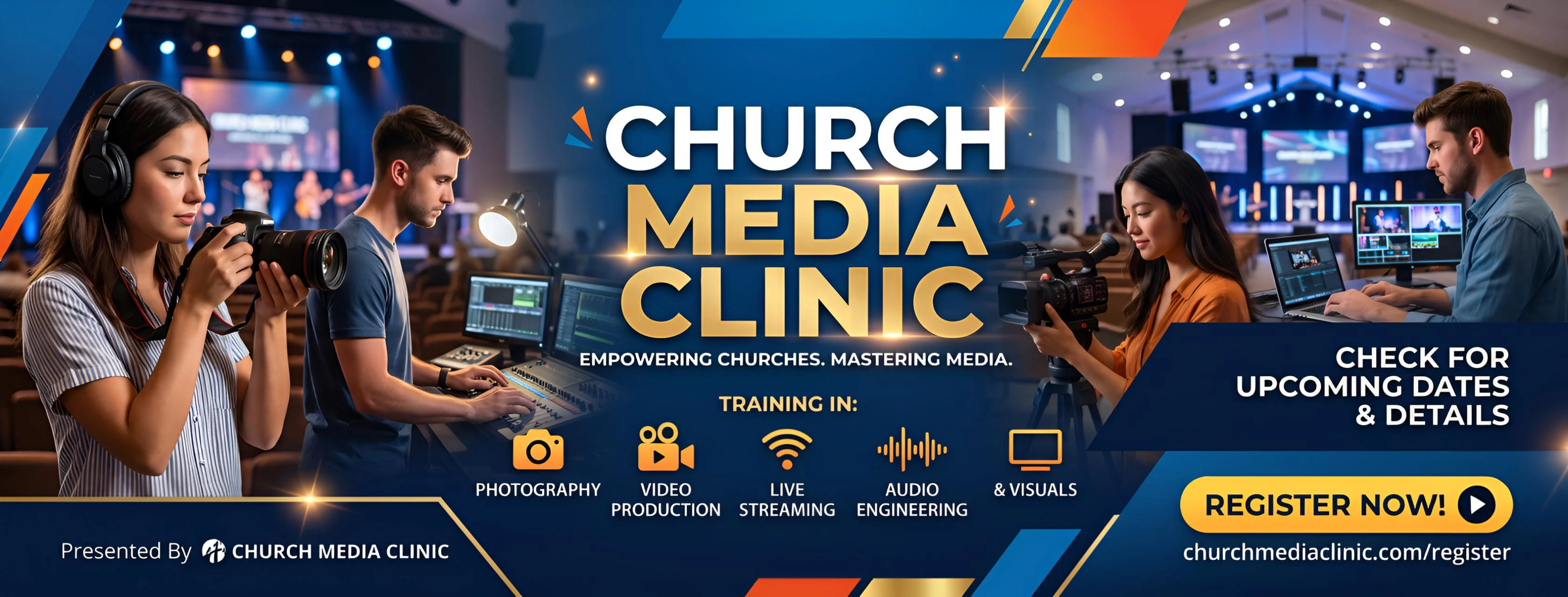
Empowering churches · Mastering media
A three-day clinic for the people who make Sunday morning possible — the invisible crew behind every camera, mixer, teleprompter, and lyric slide. Taught by working broadcast professionals who serve on Sundays.
Every Sunday, before the sanctuary fills, someone opens a control room and quietly commits
to excellence in a craft they were never trained in. They mix a live band with headphones
that don't quite fit. They frame a preacher on a camera they read the manual for last Tuesday.
They live-stream to fifty homebound members with an internet connection that isn't quite enough.
The Church Media Clinic exists for them. Three days. Five disciplines. Working
professionals. Real gear. No performance — only mastery.
— The faculty · Established 2026
Every track runs from first-principles to production-ready. Pick one to specialize in; observe the others. All five interlock — the audio engineer needs to think like a lighting designer, the video director like a photographer.
Composition, natural + stage light, sanctuary shooting without disrupting worship, colour science for skin under LED wash, the archival ethic. Bring your body; a camera is provided if you don't have one.
Camera-op fundamentals, multi-cam directing, the three-camera baseline, cutting sermons for retention, the difference between a wedding video and a Sunday service (a lot). Live switching under pressure — practised.
Encoders explained without jargon. Multi-platform simulcast. Latency, bitrate, redundancy, and the graceful failover. Chat moderation as pastoral care. What "good enough" actually means for a 200-seat congregation streaming to 40.
Gain structure. Live mixing without ringing feedback. IEMs vs wedges. The vocal chain that makes the pastor sound like the pastor and the singer sound like the singer. Recording the sermon so it's usable by the podcast team on Monday.
ProPresenter workflow that doesn't collapse mid-service. Lyric design that reads from row 22. Motion backgrounds that don't distract. LED walls, projector calibration, the geometry of stage design. The theology of what you put on a screen.
Three days, Friday evening to Sunday afternoon. Mornings are lecture + demo; afternoons are hands-on studio time; evenings are open lab. A sample programme — final schedule confirmed two weeks before your date.
Doors open · check-in Coffee, name badges, meet your track cohort.
Opening address · Why we exist Half testimony, half syllabus. Faculty introduce themselves and the week ahead.
Dinner + facility tour See every room you'll work in over the weekend.
Optional: Sunday-morning stack-up Ambitious first-timers hang late to watch faculty deploy the Sunday setup end-to-end.
Breakfast · faculty office hours Ask anything before the day starts.
Morning intensive · your track Three hours of first-principles inside your discipline. No fluff.
Lunch + cross-track roundtable Photography sits with Audio. Video sits with Streaming. Cross-pollinate.
Afternoon studio · hands-on Real gear, real scenarios, faculty over your shoulder.
Dinner + faculty panel The hardest questions from the day, answered on the record.
Open lab · rehearse for Sunday Practice on the actual Sunday setup you'll run tomorrow morning.
Call time Everyone in place, one hour ahead of the congregation.
Full-service rehearsal Cues, transitions, the sermon roll-in, worship set start. Live-fire drill.
Sunday service · you run it Attendees on the desk, on the cameras, in the booth. Faculty coach silently.
Debrief lunch Playback of the service. What went right, what to steal, what to fix.
Certificates + closing benediction Alumni onboarding, private Slack invite, and the follow-through plan for the next 90 days.
Working broadcast professionals who serve on Sundays. Not the celebrity-conference circuit — people who mix a live band Saturday night, walk into a sanctuary Sunday morning, and never miss a cue on either.
Photography · Chair
Fifteen years shooting for national conferences and the Sunday 9am at a 1,200-seat church in Dallas. Shoots exclusively on primes.
Video Production · Director
Broadcast director for a weekly televised sermon reaching six countries. Started as the volunteer who ran the middle camera.
Live Streaming · Lead
Ran the live infrastructure for the pandemic pivot of a 40-church multisite. Speaks fluent OBS and Vimeo Livestream.
Audio Engineering · Chair
Front-of-house engineer for touring worship acts and Sunday-morning volunteer at a small rural congregation. Both matter to her equally.
I have volunteered for eight years and never once been trained. I left the clinic able to explain to my pastor why we sound different on Sunday than we do on the podcast — and how to fix it before next weekend.
S. Nash · Sound tech · Grace Community, Ohio
The clinic is scaled to serve teams from any-sized church. If any of these describe you, you belong here — no experience assumed, no reason to feel behind.
You give three hours a week and you want it to matter. You're tired of guessing your way through the mixer preset your predecessor left behind.
You're the person the pastor calls at 8am on Sunday when the lyrics won't advance. You need a framework for training the next volunteer — and time to catch your breath.
You inherited it from someone who left. You don't want to become an audio engineer — you want to understand what to hire for, what to volunteer for, and what "good" looks like.
You broadcast to three campuses on a mission-critical stream. You need your team calibrated against a common standard so quality doesn't drift between locations.
Six clinics annually. Twelve to sixty seats per date depending on the host venue. Registration opens ninety days before each cohort — early birds save a full track fee.
Track fees start at $895. Early-bird pricing closes 45 days before each cohort. Group rates for teams of three or more.
Begin registration →No. Every track has a full loadout of production gear available. If you bring your own, we encourage it — you'll leave knowing your gear better than when you arrived. If you don't, we have you covered from body to lens to headphones to DAW.
Then you belong here more than anyone. Every track starts from first principles. We teach faculty to explain "gain structure" without any assumption of prior knowledge. There is no prerequisite — only willingness.
You leave with a signed certificate of completion, a private alumni network, and a 90-day follow-through mentor. It is not an accredited degree. It is a testimony to your training and a doorway into a community of practitioners.
Yes — teams of three or more get a discounted rate and a dedicated cohort-lead who ensures your team leaves calibrated against a common standard. Email [email protected] for a quote.
All instruction, all gear, all Friday-through-Sunday meals, the certificate, the alumni network, and the mentor. Travel and lodging are on you; we publish a preferred-rate list of nearby hotels once you register.
Full refund up to 45 days before your cohort. 50% refund from 44 to 15 days out. Non-refundable inside 14 days, but you can transfer your seat to a teammate or to any 2026 cohort with a seat still open.